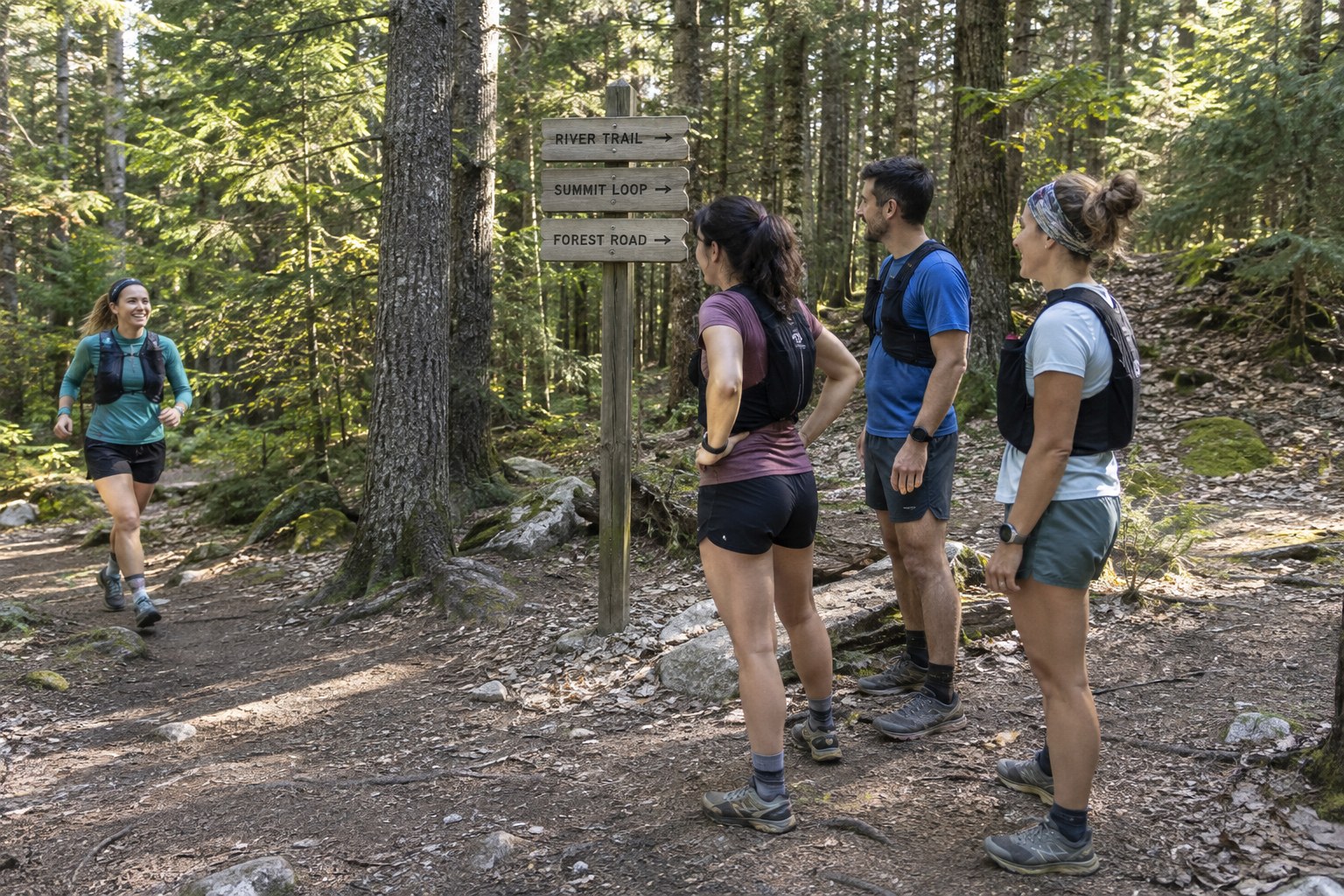
Give the junction a clear rule
Before starting, agree that the first person reaching an uncertain turn waits until everyone knows the direction. Do not rely on a dropped branch, an imagined footprint or the assumption that the track on another watch is identical. A person arriving slightly later may be concentrating on breathing or footing and miss a gesture made from farther ahead.
Choose a waiting place that leaves the path usable for others. Standing in the middle of a narrow fork can confuse passing walkers and obscure the sign the group needs to read. Move to a broad, visible spot without disappearing down one branch. Keep the people arriving last in view rather than beginning to debate the next section out of sight.
Regroup before restarting
Count people, confirm the direction and allow the last arrival a moment to organise themselves. A regroup where the leader leaves immediately can become a series of stops for the front runners and continuous chasing for the back. Ask whether anyone needs to adjust clothing, check kit or change the pace before continuing.
If the group is large enough that some members cannot hear the decision, repeat it clearly. Do not assume a message will travel accurately through casual conversation. Name the destination or landmark as well as pointing. If the route is being shortened, make sure everyone understands the new finish and transport arrangement, not only the next turn.
Keep a shared route when the pace varies
Before starting, identify who knows the route and make a copy available to another person. If the faster runner is also the only navigator, the rest of the group can become dependent on glimpsing them ahead. Agree that the next turn is communicated before the group spreads out again. On a route with many close junctions, a shorter gap may be more useful than repeated long waits followed by another separation.
A regrouping point should be understandable from the direction of approach. Waiting behind a shelter or beyond a fork may feel convenient to the first arrival but remain invisible to the last. Choose a landmark everyone can identify and keep the junction itself in view. If the group repeatedly loses contact despite these arrangements, shorten the outing or adopt a pace that makes communication straightforward. The repeated difficulty is information about the plan, not a reason to demand that the slowest person keep chasing.
Know what to do when someone is missing
Agree a separation plan before the outing that suits the route and communication options. Avoid everyone independently running down a different branch to search. Establish who is present and the last known point, then use the agreed approach. If there is a genuine emergency, contact the relevant emergency service and provide clear location information rather than allowing the group to fragment further.
Afterwards, discuss why the separation happened without turning it into a contest over speed. Perhaps the leader turned before the junction, two devices held different routes or the waiting point was hidden. Correct the organisation for the next outing. The aim is a group that can travel at a suitable pace while still making route decisions together.