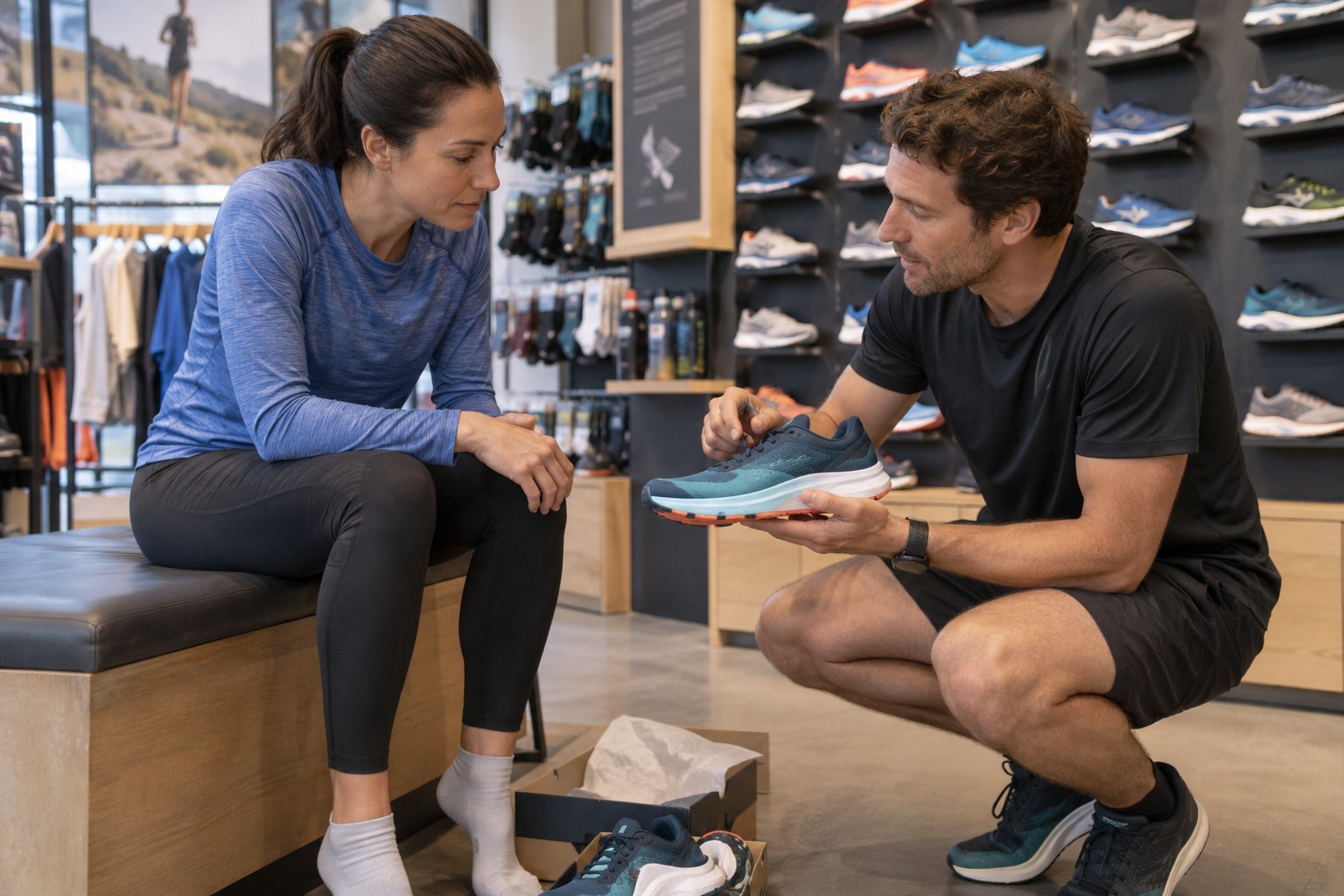
Describe the job before asking for a model
Explain where you normally run: pavement, firm paths, mud or a mixture. Mention whether you walk to the route, carry a bag or intend to use the shoes for an event as well. These details help distinguish an everyday choice from a specialist option that looks appealing but does not suit most of your outings.
Bring the socks you expect to wear and, if relevant, your usual prescribed inserts. Do not invent a diagnosis to guide the conversation. Describe what you notice instead: pressure near a toe, heel movement or a lace area that feels tight. A shop can discuss fit, but persistent pain or a health concern may need a qualified clinician rather than another shoe recommendation.
Ask what you can compare in the fitting
Ask to try alternatives with a different shape, not only a different colour or price. Compare both feet and use the shop's permitted walking or jogging space. Notice where the foot moves and whether the upper presses when you bend. A brief fitting cannot reproduce an entire long outing, but it can reveal an obvious mismatch.
Useful questions include whether another width is available, how the size compares within that brand and what changes between two versions. Ask the assistant to show the relevant construction rather than relying only on labels such as stable or responsive. Those words may describe different things to different people.
Do not assume a shoe that pinches will become suitable once it has been used. Salomon's fitting guidance explicitly advises rejecting rubbing or pinching shoes. Apply that as a reason to keep comparing rather than as a reason to buy a particular brand.
Discuss ownership, not just the first impression
Ask about care instructions and the conditions for returns or exchanges before taking the shoes outside. A shop's treadmill trial does not necessarily mean outdoor use is permitted under its return policy. Read the actual terms rather than relying on a vague promise that you can bring them back.
For a pack, lamp or watch, ask to practise the action you will perform during a run. Can you reach the pocket, operate the button or read the display? Check which accessories are included and which are optional. A lower shelf price may describe a different package.
Keep your budget visible in the discussion. If the recommendation exceeds it, ask which feature accounts for the difference and whether it matters for your intended use. There is no need to apologise for choosing within a limit.
Leave with a decision you can explain
Before paying, summarise why the item suits the job: fit, surface, access or a particular function. If the only reason is that it was described as popular, pause and compare again. You can leave without purchasing when the fit or information remains uncertain.
Keep the receipt and any model-specific instructions. Write down the size and exact version if you want to think before buying, since similar names can cover different products. A useful shop visit can end with better questions and a shorter list, even when it does not end with a bag.