Read the packet before putting it away
Identify the exact product, its intended use and any restrictions. Single-use and reusable products should not be assumed identical. Keep the instructions with the item or in a form you can readily consult. Do not reduce the preparation to remembering a colour-side rule from another product; the relevant instructions are those supplied with the blanket you carry.
Check the packaging for damage and confirm the item has not been replaced by an empty wrapper after a previous outing. Decathlon’s instructions for its single-use blanket include keeping it dry, avoiding punctures and not covering the head. Such precautions are a reason to read the actual product guidance before an urgent situation, not to improvise from memory.
Give it a stable, protected place
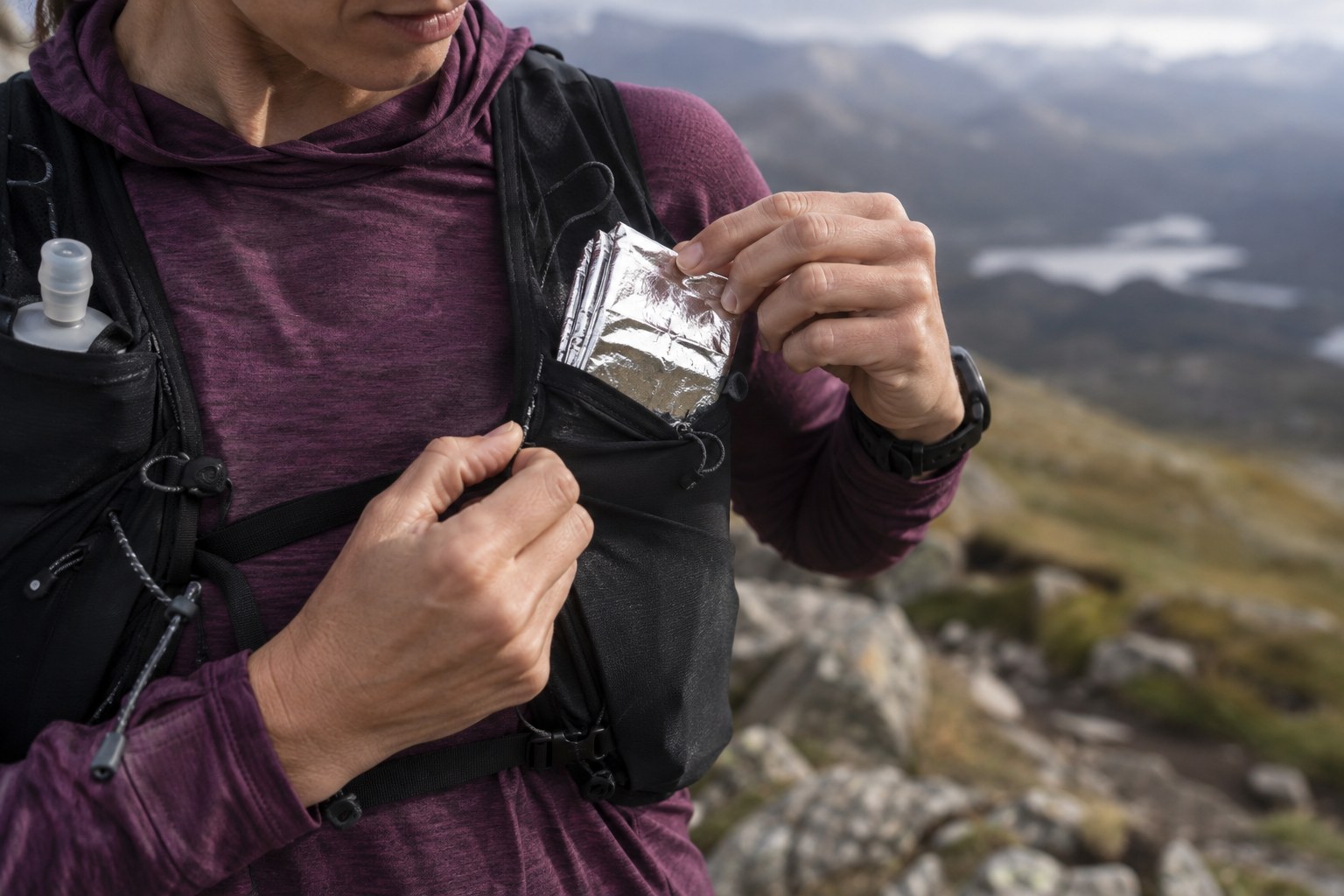
Choose a pocket that remains accessible after the jacket and food are packed. Keep sharp items and hard edges from damaging it. If an additional pouch is used, make sure that it does not turn retrieval into several layers of difficult closures. Tell a companion where it is when that is relevant to the shared plan.
Practise finding and taking out the packet with the vest loaded. You do not need to unfold a single-use item simply to prove that you can locate it. If learning the deployment requires opening it, follow the maker’s advice and arrange an appropriate replacement for the next outing rather than assuming a used item is unchanged.
Keep its role in proportion
A blanket is part of contingency equipment, not a substitute for suitable clothing, route planning or seeking help in an emergency. Learn appropriate first-aid procedures through qualified instruction and follow emergency-service guidance when assistance is needed. This packing check does not establish that one item can manage every cold or delayed-return situation.
After any use, assess replacement or care according to the product instructions. During routine packing, verify its presence and condition rather than repeatedly assuming it remains in the same pocket. Keep it on the checklist alongside communication and navigation arrangements. The aim is to make the equipment you have chosen findable and understood, not merely to count it among the things inside the bag.